Tuesday, March 12, 2019


IT ALL COMES TOGETHER


First pics, 2012


So.

The story up to this point.

In 2012, I’d been living in Little Rock Arkansas since 1986, give or take a few years on the road.

I was established, dug in, and in every way, a local.

Thoroughly enjoying my job, a beautiful new girlfriend, and everything except the impending conservative politics and heat of the summer, I had a vision while dozing through a springtime golf match on teevee.

“Go to southeastern Connecticut. Get out while you’re still young enough!”

So I made a plan. But I had to do some recon; such a move required research, whether I heard a voice in my head or not.

I found The Standish Farm the first day I arrived here and within a year, I made a deal for the house. I spent three months packing, scrambling to get every dime I could gather to pay for the down payment, the move, and other dangers such an adventure might throw at me. Things fell together almost magically, usually at the last minute. I’d fret and worry, and then I’d make it happen.

The truck was crippled with the first two hundred miles after leaving Little Rock, but I fixed it and continued. I arrived in the middle of the night, house locked, no water, electricity off, and three very restless and confused dogs in tow. I broke in and slept on the floor, even though the house didn’t technically belong to me yet.

I fixed the electrics (and the lock), built the dog fence in three days, cleaned out the garbage-filled shed to store my shop equipment, and began to work for Early New England Restorations. I battled the dog/fence situation until spring (constant escapes), then fixed THAT.

I had five years to get the house refinanced, and knew very well that I needed to do a LOT of work to get a decent appraisal or even to get someone to loan to me. My credit was good, but I worried all the same. My tax assessor became my champion, giving me GREAT advice on what to do and not do.

Adversity followed my every step; every victory was followed by two disasters. Yet I kept moving forward.

I cleared a lot of the briars and bittersweet that had taken over the property, cleaned out all the outbuildings (well, most of them), installed wood stoves, redid the living room, bedroom, kitchen and bathroom, shored the floors and roof, installed new heaters, and and and and.

Got laid off. Got another job. Quit that nightmare, got another job. Worried and worried and worried.

Built a scaffold to help support my old ass, figuring I needed to redo my roof and I’d never have the money to hire anyone. It’s been like that since I got here. Skin of my teeth every time. Tore apart the barns. Rebuilt some of the barns. Rewired the house.


After living room and kitchen restoration, 2016
 

I knew this year was the crux, the last chance, the end of all things.

Five years ago, the only way anyone would buy this house was if the owners carried the note; no local bank would have loaned on it. Built between 1701 and 1735, it had no heat, was barely livable, and the outbuildings were filled with garbage.

The Izbicki family agreed to carry the note for five years, and I really learned the meaning of Sweat Equity.

And I worried. And worried.

It wouldn’t appraise, no one would loan on it, some little glitch would kill any possibility of refinancing.

On Labor Day weekend 2018, I had two months to get the farm refinanced. I was terrified. November Eighth was my D-Day.

While doing some research on the computer, I saw an ad for Quicken Loans. My tax assessor had recommended them. So maybe this internet loan thing might be good. I called, and within a week, they took the reins and walked me through everything.

It wasn’t like I was out of the deal. Oh, no precious, not this toad. I trust NO ONE. I figured I’d have to keep my eye on them every step of the way. And I did.

But it turned out I didn’t really have to.

I was given a personal mortgage banker named Grant Niemiec with Quicken, and this guy was GOOD. Still is. I am quite the worrier and am not all that well-versed in the refinance of property, but he made it easy. If I had a question, he was there. Texted me back within an hour of any concern, guided me through the process, and understood my over-arching fears. Then he eliminated them. Even when I had problems with other departments at Quicken (very small, and usually due to me), he smoothed it all out.

Then came the day of the appraisal. I worked into the wee hours making the house ready for inspection. The appraiser understood that my home does not have a lot of local comps (comparable properties for pricing an appraisal), but he figured it out, and in a few days, I nearly fainted. My appraisal was more than twice what I owed.

Apparently this sweat equity thing  WORKS.

So did Quicken Loans.

I am not getting a discount of any sort of kickback from this company for a plug. Don’t believe me? READ the other posts on this blog. I'm no patsy. I REALLY like what they did for me.

Keep in mind that I had FOUR mortgagors. And one was dead. FOUR siblings, all over seventy, needed to agree and sign on the dotted like. And NONE used a computer.

Yet it worked out.

And on Halloween Night, eight days before I would LOSE The Standish Farm, I closed. And I did it at my favorite local watering hole.

It took me a few days to realize that I no longer had the Sword of Damocles hanging over my head. I’m still, five months later, trying to learn to relax. But I’m beginning to. Not that I completely stopped working on the property. Never will.

The barns needed attention during the early winter, so I began a big push in November. November and December are autumn months here, and I usually get more work done in those two months than the rest of the year. The temps are usually ion the thirties, forties, and fifties, the snow is minimal, and I like to be busy then.

In addition to my freedom from The Sword, Quicken increased my loan amount to replace the roof on the house, on the shop, and part of the Big Barn.

I nearly cried; I wouldn’t have to do it myself. Well, not the house. THAT was a big job. And I AM getting old.


So thanks, Grant Niemiec and Quicken Loans/Rocket Mortgage. You guys rock. You REALLY rock.

I think I can sleep in tomorrow.

But not the next day….


It's mid-March 2019. Time to get back to work on THIS. 1735 to the left, 186o to the right. I'll post the big changes since this was taken very soon. But first, a word from my roof...


Sunday, March 10, 2019


YARD GLASS


This summer I had some forced time off (laid off for a while), so I decided to do some yard cleanup. Trouble was, it was SUMMER. Eighties and eighty per cent humidity, just like the rest of the summer until late August, when we had the same temps, but it rained every other day. And it hasn't stopped. I'm writing this in MARCH of 2019. Oh, the last rain came down as snow, but the ground has been saturated since August. And though we didn't have much snow until this last week, we have had rain, rain, and more rain. It just froze after coming down.
SO!
Back to summer!
I'd been putting off getting the glass in the yard collected. It's a big job, and there is a LOT of glass. There used to be two large greenhouses at Standish Farm, and though they are gone, the previous owners (old farmers) didn't believe in taking out the garbage. Really. I have two dumps on this land that measure over forty by forty feet, all broken glass, plastic, and rusty iron. The organic stuff decomposed years ago, but I'll need a front end loader to remove it. The briars have covered it, so I don't have to look at it. A future project.
And, as I said before, each of the five outbuildings was filled to head high with household garbage, farm trash, greenhouse garbage, old newspapers, and furniture they hoped to use/repair someday. It took YEARS to clean it out (go back to the beginning of this blog if you want to see some of it), and I have yet to empty the crap from the 1860 barn and the newspapers from the 1835 barn.
But glass is heavy, so they never moved it far from the greenhouses once they disintegrated. And disintegrate they did, as they were made of wood.
I thought about what to do with it, and though I'm not lazy, I am at somewhat of a loss. It can't be recycled; window glass doesn't recycle. I dunno why, it just doesn't.


Piles of double-strength glass


Useless to me, stained and cloudy


 Ugh.


This pile, out by the "garden" greenhouse (so called because it's where my garden is today, duh), is different from the newer double strength stuff in the previous pictures. The frames are still there and the glass is much smaller single strength, a thinner variety. I'd suspected this glass might be older, and older glass is more valuable. Older glass has a convoluted, wavy surface that distorts what you see through it. It has streaks and bubbles and is prized by those involved in historic restoration. Hey! I know people like that! So I decided to set up a more-or-less cool space and tear the frames apart, liberating the glass. I knew some would be broken, but at least I'd clean up the pile.


There was even a little shade. This sumac stand grew up from a small weed five years ago, and I need shade for the shop at the upper right hand corner, so I've let it grow. It comes from the old cold frame, remnants of which can be seen at the trees' base.


As I cleared away the dirt, I discovered that the panes overlapped by 1/4 inch; not a good sign. These would likely be scratched where the two panes overlap, and those scratches would make them unusable. It would look like a foggy haze at the base of the glass. Even worse, the glass size was mostly six by eight, one of the standard sizes for Colonial glass, and also one of the smallest. It was unlikely I could cut it down to remove the scratches. I suspected this was very old glass. Damn.


The frames were hand made for the greenhouses. No horizontal muntins (wood dividers for the panes). A frugal way of making a window, takes half the work, but scratches the glass. The farmers didn't care, they just needed a greenhouse. But it also meant that they had likely salvaged the glass, and that from Colonial-era windows. AUUUUUGH! What a waste. Old glass was worth nothing in the forties and fifties when the greenhouses were built, but is quite valuable now. Note the electric chain trimmer; I did some sumac-sculpting while playing glass zombie. The pile in the background is all modern double strength and is not antique. Modern glass, called float glass, is poured molten onto a surface of pure mercury, making it completely flat. No waves, bubbles or streaks. How boring. Just like everything else today.


The harvesting begins. All of the panes are dirty, some are scratched, and some have CaCo2 staining. This white haze is caused by the calcium carbonate (chalk) in the putty, which is redeposited on the glass as the putty disintegrates. It can be removed, but it takes work. And sometimes it CANNOT be removed. Most of this cleaned up pretty well.


The work begins

 
Soaking the glass in water mixed with bleach. The bleach doesn't help clean the glass, it just keeps mosquitoes from breeding. It had to have bleach added once a week. Brown water is from tannic acid from leaves.


There was a LOT of glass, and a lot was larger than 6x8. This could be cut down if it was scratched, but most of the scratched stuff was 6x8.


 Never ending pile of at least twenty windows.


 Work in the late morning and early afternoon to follow the shade.


Getting to the end. Much more broken stuff here, but still amazingly intact panes for the most part.


 Most of the haul. Doesn't look like much, does it?


Broken leavings. The circular saw was to cut the  frames apart. The plywood kept my tiny chair from sinking into the damp soil.


 The weedeater was to expose the frames in the first place. I HATE summer.


Convoluted glass, likely early nineteenth and late eighteenth century. It was very, very distorted. The more distorted it is, the older it is. That dark line in the center is a reflection of my perfectly straight roof edge.


 Some of it cleaned up, some of it didn't. I'm still finding pieces around the property, and much is sitting in these tubs, frozen solid in March. I pulled out a bit of it during the last thaw; it was perfectly intact, without a pane broken. I will set up a cleaning table in summer and do the scrub-a-dub when its hot. Right now I'm waiting for the snow to melt. I don't hate winter the way I do summer, but I'm ready for some sun and temps above thirty.


Thursday, February 28, 2019


ATTACKED


Late summer is a dangerous time in New England, and September last was no different. I was a busy boy. Having done all of the interior work that I thought would bring my appraisal high enough so I wouldn't have to put any money down for the refinancing, I spent the entire year...well, doing what is chronicled in the pages of this diatribe. I'll go into that really soon. But one thing I had to let go this year was the yard. I was so busy with the removal of the barn roof and front wall, finishing out the kitchen, bedroom, and bathroom, (about three quarters done, but good enough for appraisal), and getting the cellar cleaned up, I let the weeds take over. Oh, I kept the grass mowed and grew a few ragged tomatoes, but I hadn't run the weedeater in months.
So one hot day I donned my overalls, fired up the Husqvarna, and went to town. I did the front yard first. Once in the backyard, I took on the weeds that grow along the welded wire dog fence; they really made the place look like, as my mother used to say, "Tobacco Road."
At one point, along the  fence section furthest from the house, my trimmer line became entangled with a piece of errant wire, and I had to set the trimmer down to untangle it while on my knees.
My hands immediately felt like they were caught in a fire. The pain was tremendous, as if a series of hot needles were being stabbed into the thin skin on the back of my hands and fingers. And because I'd experienced this exact sensation once before, I knew exactly what to do.
I screamed like a little girl, slapped my hands a hundred times, and jumped up, immediately falling to the ground to roll like a log, trying to kill the yellowjackets that were invading my overalls, long-sleeved shirt, and underwear. The ones on my hands continued to sting me. As did the others.

I am allergic to certain vespids. Yellowjackets and paper wasps especially. I have never been hit by a white-faced hornet, New England's most dangerous vespid (go back a few years to see one of THESE killers and the nest they build), but I hope to avoid that particular experience. This was bad enough. I have never been stung by more than three 'ground wasps' as others call them ('sweat bee' is another bullshit vernacular term; you'll call them by other names when you swallow one live from your open soda can), but each time this happened, I swelled up like a tick, my eyes swelled shut, and my joints swelled and hurt as if they were arthritic. I felt my throat get tighter, as well, and each time this happened, I was miles from help. And though I was worried, I survived without going into anaphylactic shock. This was before the days of epi-pens.
As I rolled and screamed, I slapped myself hard enough to cause bruises. I rolled, got up and ran, screamed in pain and rolled some more. I continued to slap my hands, more out of pain from the first stings than from anything still attacking me. All the running was intending to get me as close as I could get to my van, where I had quick-dissolving Benadryl strips as well as an epi-pen. When you are allergic to wasps, you keep your medicine close.
I continued to get stung as I reached the van and ripped open the package and put two anti-inflammatory strips in my mouth, which immediately began to go numb. Unfortunately this did not happen to the rest of my body. Ripping open my long-sleeved shirt, I was amazed to see fifteen or twenty yellowjackets fly from me. I pulled off my tee shirt and saw the same thing. Now they were stinging my legs; I wore shorts under my voluminous overalls. Finally, I sat on the van's side door floor and did my best to remove my overalls. Again, a flood of the little black and gold buggers flew off while I peeled parts of it away, but I had another problem. I couldn't get my overalls off, as my good sized  Merrell hikers were simply too big. Actually, they're not, but doing it carefully after a long day's work while sitting in my bedroom changing chair is quite different from doing it under the desperation of constant stings. Yellowjackets, unlike honeybees, have smooth stingers, as do all vespids (wasps and hornets). One can sting ten times in ten seconds. So they were doing now.


.
I finally untied my shoes, yanked them off, and removed the overalls . My overalls are size 46 waist, far bigger than my thirty eight waist. This is so I could layer clothes underneath in the winter and keep an air space around me in the summer. It also allowed the little wingstings to invade my clothes.
I continued to slap the little shits, intending on stomping them when they fell off stunned, but I stopped when I realized I had only socks with which to stomp them. The ground was littered with them. One more stung me under my shorts, so they came off as well. As did my underwear. I was left standing in the driveway in only socks, still slapping myself. I have no idea how many cars passed, but probably none. My road is pretty quiet. I couldn't possibly care less at this point. 
Once I was pretty sure there were no more wasps on me, I found a piece of wood and smashed all the half-dead ones on the ground. I threw all the clothing I could gather onto the wire fence as I turned and saw the dogs staring at me from the other side of the dog door. I imagine they had never heard me scream like that before.


And I began to swell. My hands got thick, my throat began to close. I pulled out the epi-pen (I have three) and waited. Once in the kitchen, I ran cold water over my hands, which hurt more than any other part of me. Where they stung my body, the pain was slower to wax, but my hand-stings were all on the backs of my fingers and the thin skin of the back of my hand. I can only guess that there are more nerves and muscles and less dermis or fat that might dull the pain in thicker places. I ate a couple of ibuprofen (I Be Broken, Connie named it) and looked at my hands. Tiny red dots were obvious; I supposed these were stings. I waited for the worst. The worst did not come. I went into the bedroom and put on underwear and shorts, another tee shirt and other shoes. I flinched at every touch of cloth on my skin. Not because I hurt (I did, trust me), but because I was so paranoid that I imagined any touch of something not my skin was another yellowjacket.
I'd flinch like this for weeks. 

I figured I received about twelve or thirteen stings, ten on my hands and three more to my body. But there had been so MANY in my clothes! How did I keep from getting stung?
Turns out I didn't. They stung me a minimum of twenty-eight times and as many as forty. It took days for my stings to show, and four days later, I counted eighteen red dots on my hands and fingers. Ten more were obvious on my back, abdomen and arms, and more on my legs. None got to my junk. Well, there was that.
In a few days, the pain subsided and each sting began to itch. That was when I found the extent of the stings. And I still am amazed at my ability to survive this attack without using the epi-pen. Maybe I'm not as allergic as I thought.

It took me a couple of days to approach the nest again. It wasn't hard to find; I let the weedeater run out of gas and did not approach that area for a couple of nights. I certainly could see them flying in and out of their hole from thirty feet away, and knowing how they can attack anything within fifteen feet, I kept my distance. I was now really paranoid of anything flying near me, and remained so for the rest of the autumn. But I destroyed that nest a few days later. I drowned it. There were three holes, and I put my hose right over each hole and flooded the buggers. It took all day, but they all drowned or disappeared. I still avoided the area religiously.

Two weeks later, when I did some touch-up painting in the bathroom, I was washing out my paint buckets by the dog fence near the garage, about fifty or sixty feet from the nest. As I put one of my buckets on a fencepost to drain, something buzzed my face, and I jumped back in time to see that I had nearly stepped onto another nest. They were streaming in and out of a series of holes scattered over three or four linear feet of the fence, and I shook my head. "At least I avoided it this time," I said, going for the hose. This time, the water did no good whatsoever. I flooded that nest for days, using thousands of gallons of water. They'd move over and create a new hole.
I finally got a couple of cans of long-distance spray, and since it was now October, I waited until a cool morning and flooded each hole with a can of that horrible poison. I HATE using chemicals, and hate putting things in the ground where I have no control over them, but I would be damned if I got stung again. In two days, I could approach the nest and fear nothing at all.
I never did the weedeating around the fence. I got too busy with the last part of the refinancing. At least that's what I told myself as to reasons. You can be the judge. I will clean up the property this spring. Yellowjackets are a late summer phenomenon around here.
I'll still keep my Benadryl and epi-pens nearby.

VAN

Remember the Red Van? You can go back a few years to see what it looked like when I found it in the woods. The last time you saw it, it looked like this.


It was barely running, and I had just started the body work. Mostly to get the penis off the side panel.

Now it looks like this.


Still not finished, but much better. Rides like a Cadillac. Needs a grille, mag wheels, and a way to paint behind the side logos. Oh, yeah. Real paint would help..

KITCHEN


Time was running short as I finished the bedroom wall painting, bathroom trim, and bedroom window work. I spent some time in the shop cutting, sanding, and varnishing the beadboard for the bathroom as well as the flat stuff for the kitchen. As in  much of my woodwork I'd add to the house, I used antique southern longleaf yellow pine, often called 'heart' pine. The stuff is between three and six hundred years old, having been harvested in thelate 1800s from old-growth trees over three hundred years old. 'Heart' pine is a bastardization of the word 'hard' pine; the quicker-growing shortleaf yellow pine is much softer. I gathered most of this as cast-offs from my job at DCAM, a millshop specializing in not only fine millwork from new wood, but from reclaimed old-growth wood such as this. I prolly already tole you this, but it can't be repeated enough; I owe a lot to DCAM and Brian Cooper for his allowing me to carry off the cut-offs from my job as Woodmizer operator. Hey Brian!
I'd already done the southeastern corner with this wood in a board-and-batten design, so I needed to finish the rest of the woodwork to match it.
But this is my KITCHEN. I LIVE in this room. The main fireplace is in here, the little teevee that only gets PBS (the only channel I get, and though it's enough, it's the BEST) is in the corner where I used to keep the bar when I had friends, my kitchen table where I write all this crap, and the stove. I carried this stove from a restoration job at The Boyle House on Arch Street in Little Rock Arkansas (Thanks, Cassie! Yoou're the BEST!). A 1980s O'Keefe and Merritt 36 inch gas job I installed in my last downtown home, I've rebuilt it a number of times. Like me, it's old, but works fine and can be updated with new parts.
What it didn't have was curb appeal. I would give it that, and it would be a royal pain in the ass.


The dogs fled their usual corner-of-the-room hangout when I began to set up my miter saw on the very stove upon which I intended to update. Good thing, I would have kicked them out anyway. This thing is a workhorse, and I like to cook. The kitchen has a bake oven built into the fireplace (1735 or thereabouts), and I use it for (of course) storing kindling for the fireplace. There was an ancient gas stove in the house when I bought it, and that thing had a heater built into its side. I tried it when I first came to the house and nearly died in the badly burned exhaust fumes. It went to the curb that afternoon and was gone in an hour. Scrap is scrap.
This pic was taken when the kitchen trim job was almost complete. My goal was to make the back side of the stove, normally hidden by counters and cabinets, a highlight of the room. Cheerio's chair sits in front of that black-painted recessed surface that was never intended to be seen. The battens can be seen leaning against the fireplace.


Installing thre battens. The stove had to be framed out with specially-planed  1x and 2x lumber to give me something upon which I could attach my antique heart pine boards and battens. The boards are wider pieces, the battens the less wide ones. I left a space  at the bottom for all the electrical and gass connections; I wanted them hidden, and they will be when I install the door. I also set the entire stove on a steel platform that has wheels. This is so I could move it around the room.
You see, my kitchen is the center of the house, and though I have had a (very) few individuals over for dinner, it has always been one person at my table against the front windows, and that person is me. I figure that it is possible that some day I might not be so much of a recluse and start actually try to LIKE humans (extremely doubtful), and I might actually have more than one person over for dinner (to feed, not to eat; I can cook those outside). But the only way to do that would be to pull the table from its windowside position, add leaves, and move the stove. So it's on wheels.
I've set it up so I can move it to the corner where the gas heater is, and their connections are the same.
I needed more light and so found a couple of small reticulated desk lamps and drilled holes topped with steel washers in which to set them. The washers make it swivel better and save the wood from gouging. I'll trim the overlong wires later. I installed a power strip at the top; not the best model, but I'll find a better one.
So you see?
Good.
Let's go on to the next slide.
Kimbrell? KIMBRELL!!!
CHANGE THE FRACKING SLIDE!!

Ahh, there, now.


On the right is what I did last year, when I was alive and had (some) hope. Then I decided to sort of finish the Kitchen Woodwork. What a maroon!
But you can see that I wrapped the antique new wood around the dishwasher, another castoff from another friend. Prolly already tole you.


Bout frinkin time. Installed this thing three yuears ago, use it twice a month. Finally trimmed it, and its back that faces the music room. That sheet in the background covers the digital guitar synthesizer and other electriomics.


THIS is why I care about my stove, incomplete as it is in these pics. I LOVE to eat good food and I cook a LOT. To prove it, I encountered this weird-looking vegetable at one of my favorite Good Food markets, Herb's Market in Montville, Connecticut. If you can get there, DO IT. Jeff had this vegetable and had no idea exactly what it was, but told me who grew it. I know the guy and he has lined my tummy with some perty formidable stuff, so I bought it.
AND ATE IT!!!!
It wur guuud, as I used to say back in Arkysaw. Sorta like brokkly on steeroids. With some Pete Townshend thrown in. YUM!


THIS is the reason I have a stove. My mother used to make a Pork Roast, and I loved her recipe. But her recipe called for a boneless rolled roast, a sort of tenderloin.
When I grew up I adhered myself to using a bone-in Shoulder Roast, often callec a Boston Butt. Don't ask me why. It's too disgusting already.
But not the recipe. It's gorgeous.
Get a six to ten pound shoulder roast, bone-in preferred. Trim the huge hunk of fat from the bottom; it's highly marbled and doesn't need any more. Place it in a rectangular Pyrex dish and rub it all over with ground or rubbed sage. Dry, not fresh. Use a thin filet knife to spear it about twenty times from the top and insert slices of fresh garlic into the holes. Cover with with REAL sour cream (no carrageenan or locust bean gum, now) and fresh cracked pepper. Put it in a 325 oven uncovered for 25 minutes a pound and drool as you fill your kitchen with the most amazing scents. Then throw it away and go to McDonald's for a classic McRib.
No, No, NO! I don't know who said that, it wasn't me. Let it sit for thirty minutes after you take it from the oven and slice it and eat it. Save all the drippings for au jus or gravy or to add to the frying pan thing I'm going to describe. Makes wonderful sandwiches cold and you can take big slabs from it, put them in a wide frying pan, add onion and broccoli, paprika and spices, put in cream cheese and a little water (don't forget a few spoonfuls of drippings), and eat like you mean it.


This one had no bone; I used baling wire to wrap it up and made it the same as above.


Yum.


I like stir fry too.


It looks like I cook with antifreeze and jigsaws. I don't know why I took this picture. There's a Cape Cod in that glass. That might 'splain it.


Sometimes I create things. There was an inexpensive tenderloin roast (rolled) on sale so I took it home, cut it into a lot of sections for freezing, and saved one piece. As I've said, I don't like rolled roasts; they have no fat, and fat flavors the meat. I unrolled it, stepped back and said, "Hmmmnnn…"


I made a paste from garlic and fresh basil (sort of pesto-like) and things I can't remember, then schmeered it on the meat.


I rolled it up, brushed it with olive oil, and put a dry rub of paprika, sugar, salt, and pepper on the thing. Then I smoked it for a few hours until it reached 170 degrees.


It was okay, but would have been better with more fat.
The dish is from the "I Love Lucy" TeeVee show.


Le Pot au Crock.


Le Interieur of Le Pot au Crock. Filled it with quartered golden potatoes, onions and carrots, added soy sauce, crushed red pepper, kosher salt, dry mustard, paprika, granulated garlic, celery seed, ginger, and sesame oil. Top it all with country-style ribs that have been seared (but are still uncooked) on the grill. Throw on chopped capers and more spices. Cook on low overnight and wake to the most fantastic scents throughout the house.


It's quite edible, you know.


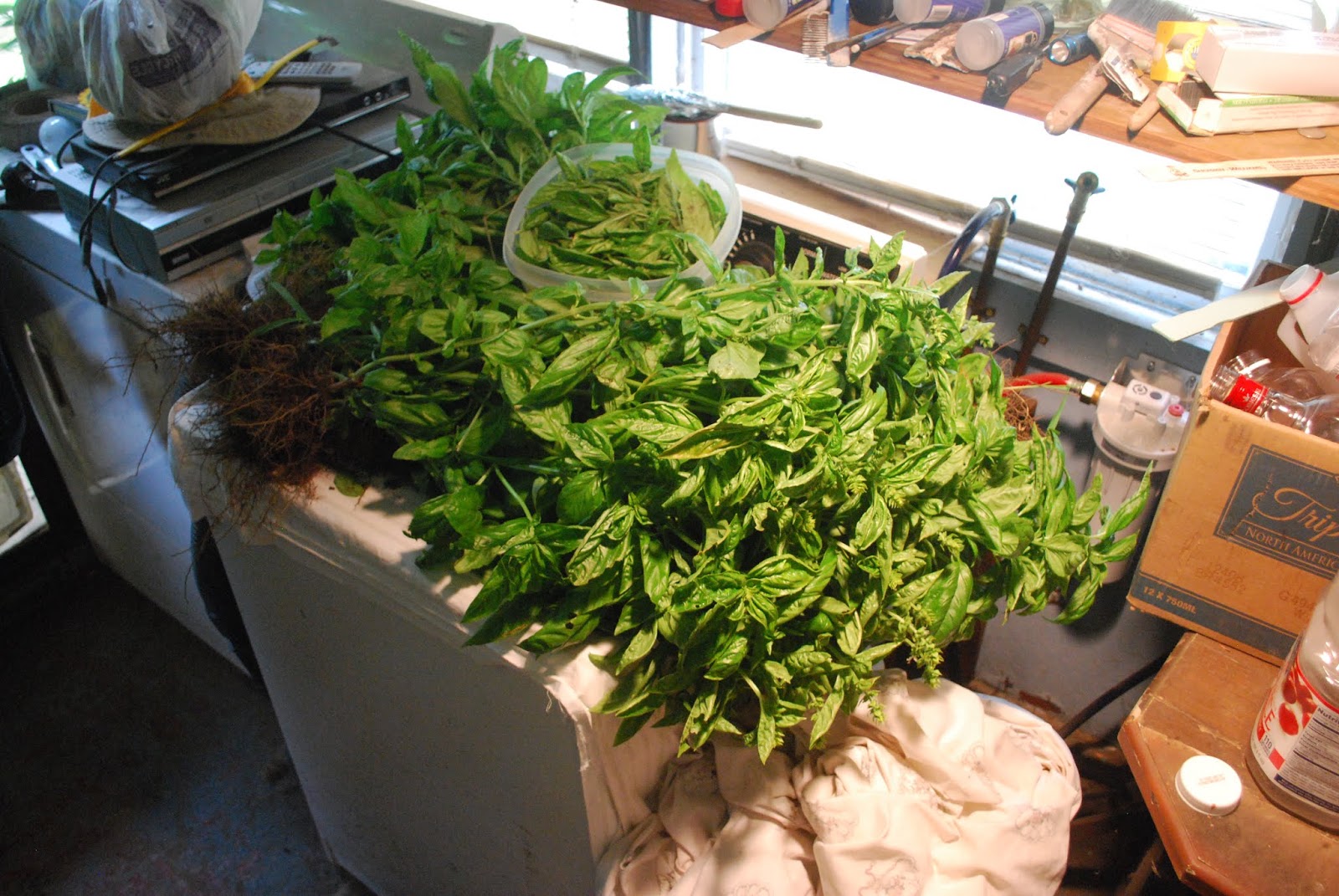
My basil garden's second planting in August. It was one hell of a year for basil.
Volunteer cherry tomato at right. Harvest them green and put them in empty Claussen Pickle juice. Eating them now in winter.


There's no such thing as too much basil. But it took me two days to make a TON of pesto from this batch. Most is a-freezin'.