SPRING
Wait....It's coming....Soon......
Or is it?

This was winter. Sorry for the pic, I was shaking from the cold and I only wanted to get back IN. Temps dropped into the below zeros in early December, normally an autumn month. A month that has no bugs (a big problem here), cool temps, and no snow.
Not this year. Coldest December on record. No property cleanup. Snow. Hibernate. Not enough wood cut for the next few months, and I'd need it.
Damn.
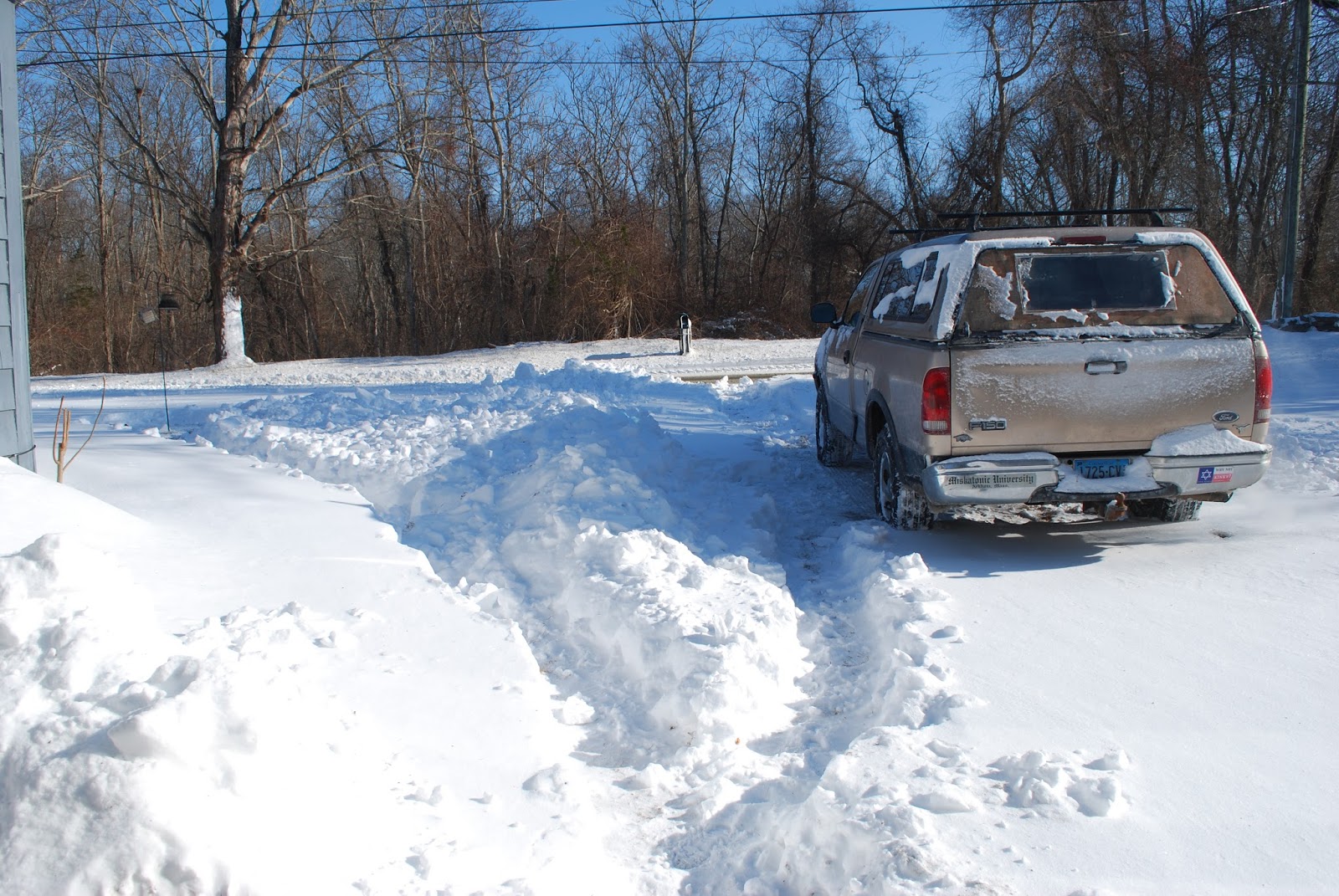
February normally looks like this, and that several times a month. A lot of foot-deep snows.
Not this year. February was WARM. We even had a few seventy-degree days! All of us thought that maybe the Winter was over, having come early, and we'd be spared. This pic was taken just after Christmas. Note the snow on the tree trunk across the road; it's on the south side. December storms come out of the south but blow dry powder from the northeast. Not this one. It was wet.

No going in the cellar today. At least I fed the birds.

Note the lack of snow on the roof, usually a sign of a Noreaster, the wind whipping the snow to the south and off the roof. This time it piled up on the southern addition roof.
December, my ass.

I couldn't cry and whine about not being able to do the work I expected to do (I usually do). I turned inward, beginning the sequel to my last novel, finished last spring and polished all the rest of the year. This last year was the Trial of Trials. Job (the bible Guy) and I could compare notes.
Instead, I killed mice. This one met with a rubber mallet when the snap-trap wasn't strong enough to kill it. Stick with Victor traps, people, or you'll be bludgeoning the little buggers as the squeak.
AWWW, you say. You're cruel! Go to Hell. This little bugger was in the desk eating my stories, shitting and pissing everywhere.
Not no more!
The bag next to him (her, I don't care) is filled with others of its kind, likely relatives. I save them and freeze them to feed to the Raptor Recovery Center in Stonington.
Kills 'em twice!
For you bleeding hearts that live in apartments in the city, I also kill squirrels at my feeder. Been pocking them with pellets in the butt for years. No more. I kill 'em and leave 'em at the base of the feeder. Their brethren leave the feeder alone for a few days. Then they come back and don't care.
I saw one sitting on a dead one chewing seeds.
So now I'm back to pocking them in the butt. Most of the time.
Living in the country will make you a bit more hard-edged than you might have thought yourself before.
They're SQUIRRELS.
Plenty more where they came from. LOTS more.

Stocked up with small wood for the stove. Much more was gathered and stashed, despite December.

This is now where I work and what I do. I restore old windows. The gig taking care of apartment dwellers in restored mills was cool until the assholes from Upper Management decided to micromanage me. Trust me, I know more than they.
Bye-bye on the first of the year, which for me, falls on November First. Always has.

Sweet little December snowfalls around the third. Three inches at best. I knew something was going to change, but didn't expect it until January.
I NOT KNOW!

Meanwhile, after ditching the Lousy Job on All Saint's, She Who Lives Upstairs told me to get back into restoration, and that right quick. That was on November first. By the fifteenth, I had joined Steve Marshall, The Historic House Guy, in his window restoration shop. Best move I've made in many years. The Old House Doctor joins up with Marshall, forming the alliance known shopwide as The Old Historic House Doctor Restoration Guys.
I said it was shopwide. You're the first to have seen it in print.
Above,
Restoring a door. Piece by piece.

A large Pediment. We don't just do windows, just mostly. Hunh?

Using a quarter-sheet sander to set glass in backbedding before glazing the newly-restored window.
And you thought all I do is rip up and repair my old house. YOU NOT KNOW!
No, there is no sandpaper on the machine. That would defeat the purpose.

Any one of my two readers will remember the old red van I went on and on about last year. Well, the F-150 pickup gave up the ghost when its clutch slave cylinder shit the bed, so I had to move quickly in December (WHY DECEMBER??!!!!) to get Red up and running. This is a pic taken in February, on a sixty-degree day, on Red's first outing. I felt guilty every second of the half-day trip because I was not working on the property. But all was frozen, despite the balmy temps. Still, I don't know how to relax until I collapse.
This is the lower end of the Connecticut River near Haddam. The December freeze was so dire that the Coast Guard (the Academy is nearby in New London), or maybe it was the Navy, across the river from the CG, brought in ice breakers to clear a shipping channel in the River. ALL rivers were frozen in by Decemeber, and even in February, no icebreaker has ever been used to clear a channel for shipping in CT. Bitter fucking month, let me tell you.
Note the huge slabs of ice piled up on shore. Don't touch them, they'll break your arm. Then you fall between them and get broken for real.
Nobody does that. We ain't that dumb up here. Cold weather makes you smarter. Folks from southern Georgia would hoot and holler and daince onna aice!
Then they'd scream and get crushed.
No great loss.
Damn, the cold makes me bitter.

Inna mean time, my computer died. Do you know what its like to be a writer with NO COMPUTER????!!!
So I brought out the old notebook and began blocking the sequel to The Adventures of Shrink McCool: The Wormtrove. I always block out my stories by longhand upon anything on which I can write, thus the plethora of envelopes and scraps filled with notes for the new book. All those have since been transcribed. I'm very pleased with it, and also with the new computer.

The window work continued through the winter. Here I'm scrubbing the excess glazing putty from glass using calcium carbonate, which we Pro-Fesh-In-Ulls call 'whiting,' but you common scum call 'chalk."

Meanwhile, the warmth of February (did I really write that?) gave way to the promise of an early spring. Everyone talked of April being like April should be, with flowers and budding trees.
"Bullshit," I said darkly. "I've SEEN the wooly bears. Black heads, orange bodies, and black asses. We're in for one FUCK of a March." I paused. "REMEMBER December."
Everyone pooh-poohed me. "You forecast your weather with caterpillars?" they laughed.
THEY NOT KNOW!
Trust the wooly bear caterpillars.
The pic above shows Red, now fully functional but only half-primed in paint, sporting a six-inch snowcap on the thirteenth of March, the forty-first anniversary of the Second Westmoreland Expedition into the Attic of Dead Dog Number Two, one of the most dangerous caves in Texas.
I survived, as did my team. And we reached the virgin territory of The Attic, which I named (but not until W.E. 3, a year later).
The Expedition was also named not only BY me, but FOR me.
Hey, I thought it up, and it took three attempts and three different teams.

March snows are dreaded because they are WET. This one was no exception. My yews, which are dying, bowed to this one's power.

"Damn, this is heavy," I thought, not venturing beyond the back door stairs.

"Christ!" Eighteen inches!!!"
Note that the dogs (Speckle, mostly) had already blazed a path.
Little Cheerio, the Shit-Zoo, likely told them to do it. She IS the social director of the Big Dogs.
And she needs to pee more often, having a bladder the size of a peanut.
Tippo of the ol' hat to Tatum O'Neal! From "Paper Moon."
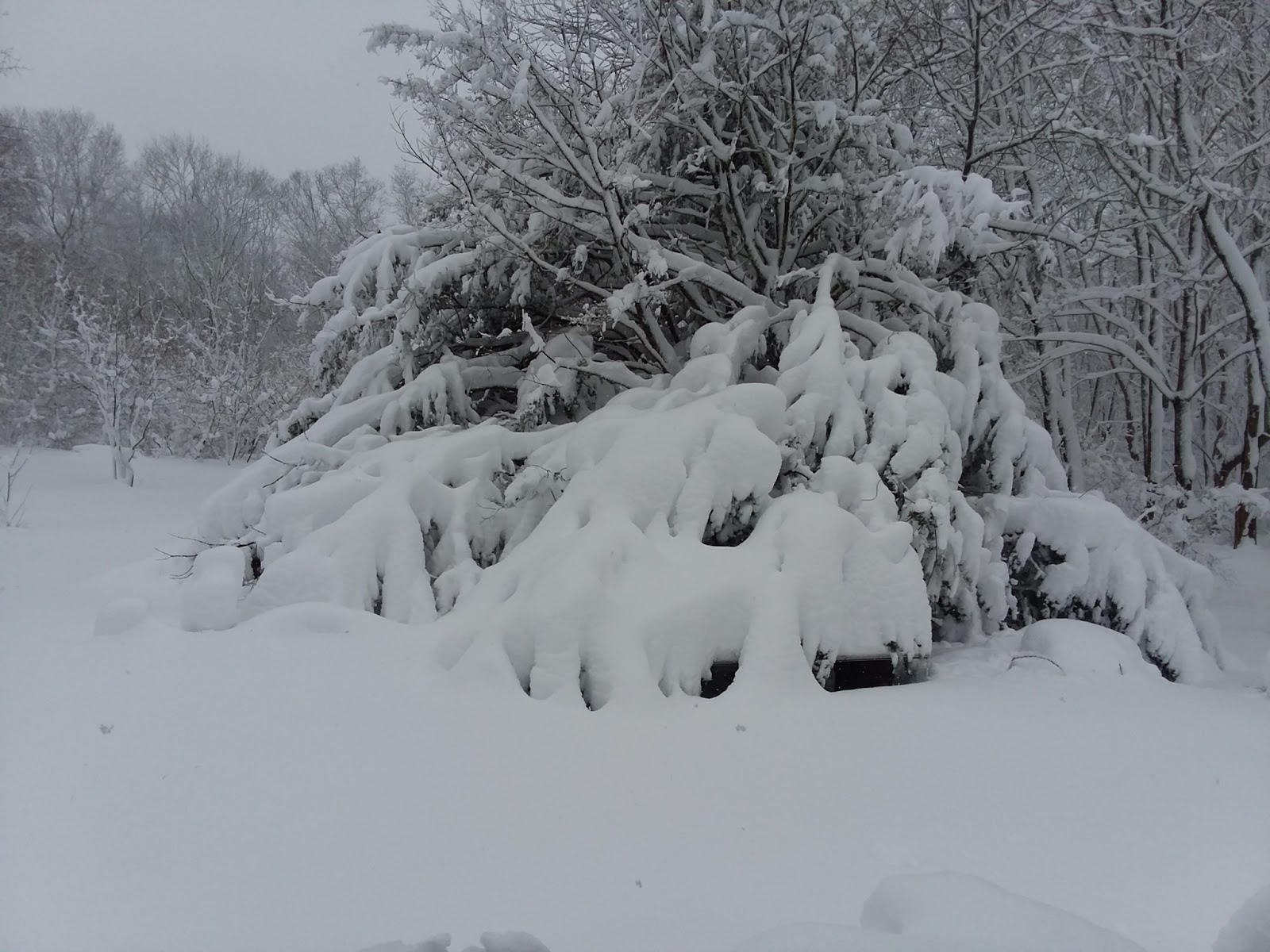
The yews, more unhappy than normal.

Red, sporting a serious snow-hat.

Sporting a mohawk. Which, in this state of fines and taxes, can cost you a hundred and fifty bucks.
Two hours of digging.

April fifth. The drive home was scary. Shouldn't this shit be overwith by now????
I have a serious aversion to driving among others of your species, and so take great pains to avoid highways and so travel country roads. My route to work, which takes an hour each way, is more than beautiful, it is calming. I hope to post some pics of the Natchaug River, Chafeeville Silk Mill Ruins, the Gurleyville Stone Mill, and other wonders I pass each day. All this to avoid contact with your cretinous species. Especially when you creatures are behind the wheel of a mechanical contrivance.
But I knew this was likely to be the last snow, and I took my chances on my backwoods route home. You know the one.
Start at Miller Road, zigzag through Greenville on Twelve, hook onto Ninety-Seven though Taftville (with the largest thread mill in the world, presently being restored), then through Occum and Baltic, finally getting out of the Mill Towns on the Shetucket River and rambling though the farm country up to Scotland, the only 'town' (it's more of a tiny village) on my route.
Sigh.
Do a little jig and a small jag, then hook onto Brook Road, which winds right alongside three of the finest little trout streams you've ever seen, going from Brook Road to North Brook Road, then to Brook Road Extension. I have to grit my teeth and run up Route 6 for three miles; this is a serious four-lane where you will DIE if you drop below sixty MPH. But from this I get on the tiny Route 198 for a quarter mile, where, after I cross the most picturesque Natchaug River (Oh MY!), I turn onto Bedlam Road (watch out for the huge flocks of wild turkeys! I'm not joking!). This jigs over to Atwoodville Road, which winds through a tiny scattering of Colonial homes, crossing the Mount Hope River (mind the trout fishermen, who park like the morons they are [no-necked knuckle draggers] along the side of the road below the NO PARKING signs in the middle of this pristine wilderness). From there, take a slight jog on State Eighty Nine to Mulberry Road, which winds through parts of Mansfield Hollow State Park to tee into Chafeeville Road (by the old Silk Mill; yes, we grew and wove that up here at one time). It's pronounced CHAY-fee-ville. It also doesn't exist. Chaffeeville Road winds between steep hills and jagged schist ledges that poke out into the road (I'm not kidding), past farms and forests, coming to the center of Gurleyville, a quaint little village crossroads whose left turn goes over to the University of Connecticut (UCONN!) and is the home of Peter Tork, the original bass player for the Monkees.
Despite going through Gurleyville every day twice a day, I've never seen him. It might be apocryphal, I dunno. Like I'd recognize him from the 1966 album covers.
Finally, my countryside expedition ends with a three-mile jaunt on Codfish Falls Road, which runs beside Fenton Brook (more a River than Brook). I have to again grit my teeth as I do a mile on Route 44, though Mansfield Four Corners, onto major Highway 195, and after a quarter mile, into the hidden parking lot of the shop in which I work restoring old windows.
See how easy it is???
I do the same in reverse on the way home.
The drive is beautiful, calming, and invigorates me every day, twice a day.
Eliminate the small stressors in your life and the big ones will take care of themselves.

Still, this was my last day driving in the snow. Without the four-wheel drive of my F150, in a thirty three year old rear-wheel drive van.
To top it off, I'd removed the three hundred pounds of sand from the rear of the van and switched out the metal-studded snow tires for warm-weather tires three days before.
WHY??? I hear you ask.
Because the State of Connecticut, in its ultimate wisdom, will fine you four hundred dollars for driving with such tires after the first of April.
Forget that April has snow. Just for a minute.
Okay, you can start remembering again.
I, on the other hand, KNEW this to be the LAST snow. I just knew it.
Because if it wasn't, I'd find God and kill him with my bare fucking hands.
God Knew This.
And I FINALLY got to work.
The first things I needed to do once I was (relatively) sure the never-ending snow was over was to...do the things I had intended to do in December, normally my busiest month here. I tackled the biggest jobs first; I had fifteen pounds of winterweight to lose, a body weak from doing less-than-normal physical activity (standing at a table for a living), and a bank account drained of savings to get Red operating once Baby (my F150) took its much-needed break.
Every action hurt my body in ways I had not expected. My spirits had been down, a deep depression was still on my tastebuds from the abuse I took at the maintenance job and a decidedly lonely existence (self-imposed, I know). I needed to replenish my savings account; two huge expenses lay ahead for this year. One, to replace my eighty-year-old electrical panel with a new breaker box, which would cost two thousand bucks, and Two, replace the roof. I'd hoped to hire this out, but it would cost four thousand or more, even with this tiny roof. I sighed, realizing I'd have to do it myself, probably in the hottest months. And I had a hard time just walking around the property. I was five years older than when I started, and the terrible injuries to my right side from the deer-motorcycle accident in 2011 were singing me their praises daily, and getting worse.
But it's gotta be done.

First task; build staging on the back of the house to allow me safe access to the back roof. I'd do this side first; if it took a long time or was problematic, I'd be hidden from passerby and neighbors. I'm neither proud, unrealistic, or stupid. It would be a Hurculean task for one fifty-eight year-old cripple. Strip the roof, repair the sheathing, called 'roofers' up here, install thirty pound felt, then 1 x 3 purlins parallel to the rafters. This would allow for a three-quartrer inch space between the new plywood and the felt, creating an air space to ventilate the roof once a ridge vent was installed. On the half-inch plywood I'd have to install underlayment, then architectural shingles. The shingles would be the easiest part. I have no friends and therefore, no help. If I get some cash set aside, I can pay for some help with plywood and underlayments, but this is unlikely.
With no money, I went through my years of collected cutoff wood from my three-year stint at DCAM (hey Brian!). Destined to be cut up and tossed in the dumpster, the haf-rounds, hand-hewn edges, slabs of hemlock, heart pine, and white pine barnboard and flooring would come in handy now. I used the half-rounds (live edge is the real term) for uprights and smaller two-by cutoffs for braces. The pink stones are scarfed concrete pads from a friend.

Workus Interruptus.
Paying money to Our Corporate Government so they can bomb brown people around the world. Must spread the doctrine of Corporate Dominance and Economic Slavery! It works here, it will work there!
Am I bitter? You bet! I'm presently paying back all the subsidies I received in 2016 that allowed me to get the worst health care Iv'e ever received. All because the State program that handles Obamacare (a fairly decent program abused by the insurance companies) told me I was eligible. I wasn't. Eight thousand dollars from me to the Corporation of America. Thanks, health care! I'll never use you again and will never trust any governmet forever! What a program!
As an adittional incentive to love our overseers, I get to pay a penalty next year because I cant afford Obamacare anymore! Yippee! Fine me for being poor! No more health care for you! You should be glad we quintupled your premiums every year and made you pay most of your health care costs anyway! Here's a twelve thousand dollar deductible!
Don't complain; we ALL voted Blue Cross/Blue Shield into Congress.

Still cold on Earth Day, and Speckle likes the fact that I'm frugal and smart enough to use the last of the firewood. I did, too. This all-night blaze was just starting.

During the snow months, I finished the rewiring of the house in anticipation of not being able to afford the new panel. It had to be done, and I WILL put in the new panel; am saving up for it now. While running a wire along the rear sill, I saw a piece of rusted metal. Thinking it was a machete I lost last year (weird how we think; I lost it in the briars, not on a three hundred year old timber under the house), I pulled this old knife from its perch of likely a hundred years or more. It is ground, not folded, which means it was cut from a piece of steel in a factory, not made by a blacksmith. It has a stamped label too corroded to read; I may clean it up and regrind it, but I like to leave such artifact intact.

The knife is large and VERY thick. It has three rivet holes in the haft, and looks to be more of a farm tool for butchering rather than something used in a kitchen. So how did it come to be in the house, and moreover, what was it doing on a sill in the basement, six feet from the floor?

Thickness almost three eighths of an inch at the shoulder tapers to less than a quarter at the end of the tang.

The last bit of snow led to a week-long Mud Season. Goodbye and good riddance. We were all Jonesing for Spring. And none of us believed the snow was over.

Mud.

And it wasn't! This was from yesterday, Cinco de Mayo.
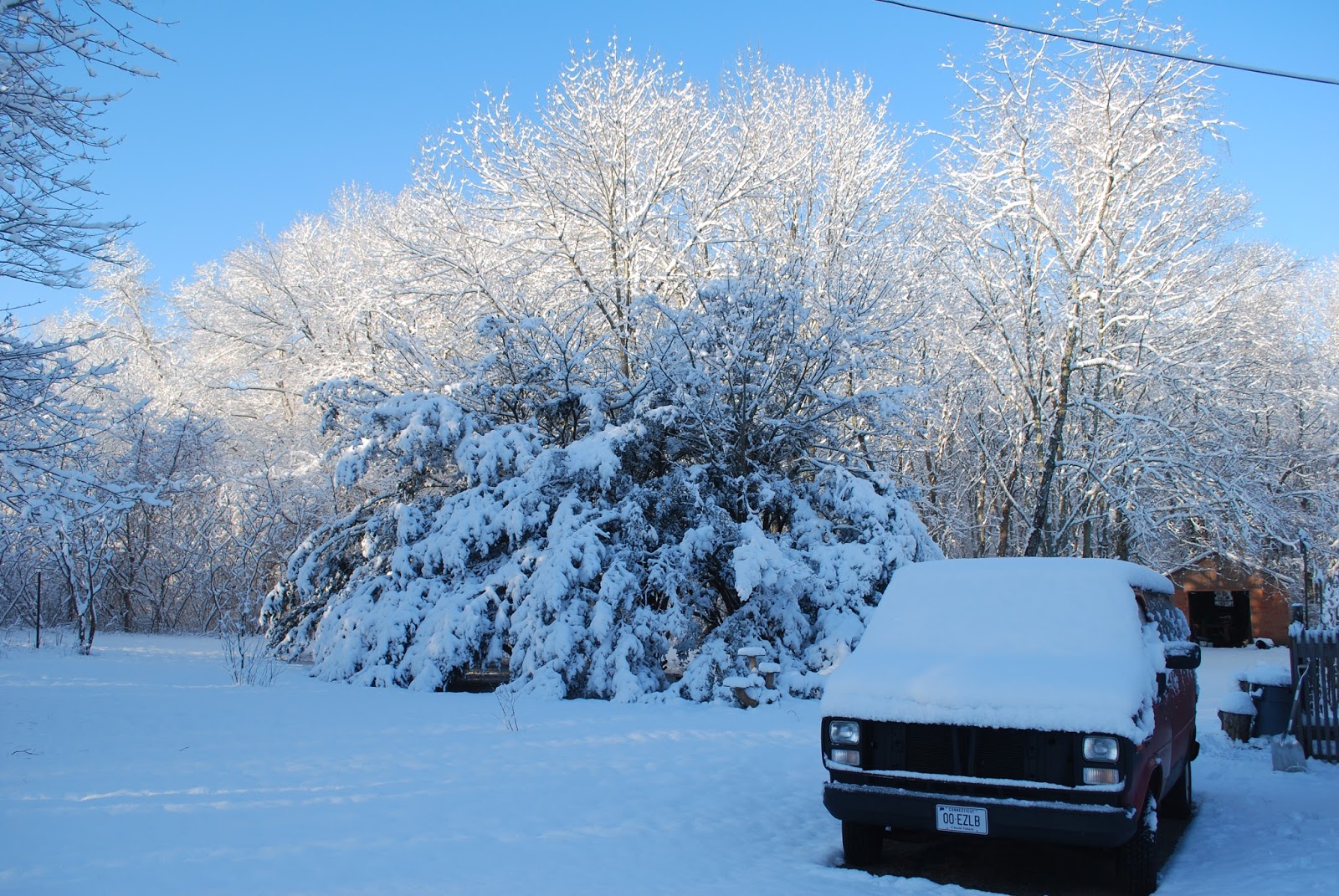
Not really! But we all expected it. This was actually the last blast in late March.

Speckie the Canine Snowplow after the mid-March Blizzard. Eighteen inches is nothing to her. Let's play!

We really did expect this to happen again; many of us had nightmares.

*SIGH*
Another day of digging out.
Finally in the past. Until next winter.
Hey, I don't have to deal with the Arkansas Heat from April until October anymore. This winter was tough, but we have a beautiful eight other months.

I came home one day to find the scraggly forest across the street cut down and ground to bits. Most trees still stood, but I saw a few marked with orange tape. This meant the others would be cut down. It also meant this piece of briar/poison ivy/bittersweet tangle was being converted to pastureland. It's a big movement up here; old fields, long abandoned and turned to messy scrub or new forest, are being cleared for agriculture, either growing vegetables, corn, or running cattle. It will raise my property value, make the place look better, and the addition of cows will give Speckle something to bark at. I had mixed feelings at first, but I think it's better this way (or will be when they finish). Cows are better neighbors than humans. Better creatures, in my opinion.
I was concerned that they'd destroy the two-hundred years of day lilies and daffodils by the road, but they left the beds alone.

One of my scarfed Japanese maples I planted in the front yard last fall; it has buds! It's been growing under the larch
"...The....Larch..."
for two years, along with its two siblings. I intend to let each get no higher than six feet, and will trim and wire them as I would bonsai, which I study. They will be fine perches for my puppybirds upon which some can crack seeds.

The other in the front yard. Just a twig now, but wait!
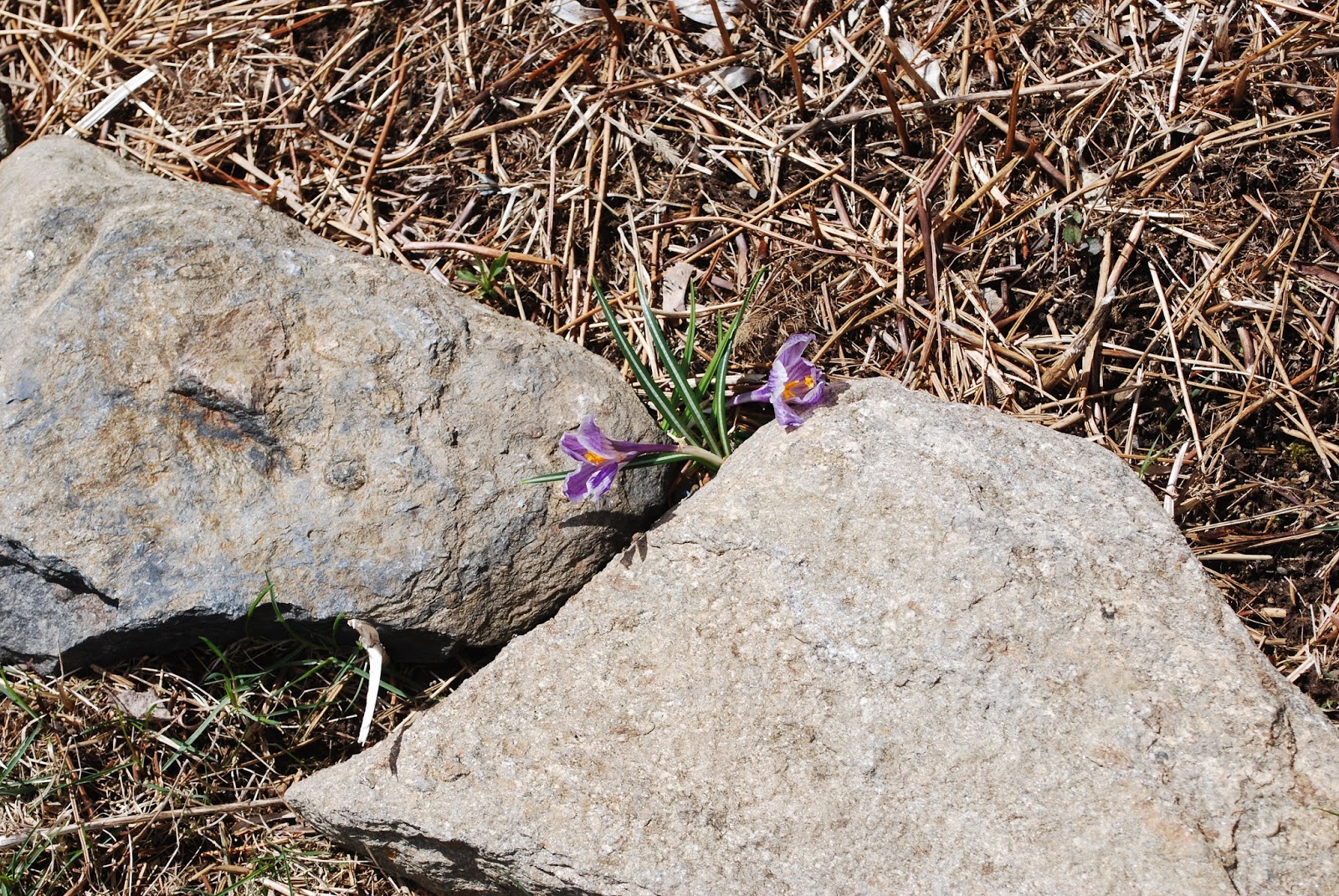
One lone little crocus peeking out from the rocks from Samara Morgan's well (remember her? I'm not sure what happened to the poor little girl...), since dismantled and lining the front garden. I got tired of planting flowers and bulbs there each year, only to see them destroyed by the billions of moles that festoon the lawn's underground. So last year I planted some climbing nightshade from the giant one in the side yard. This suff will choke out everything else, is indestructible, needs no care other than constant cutting back (or it will engulf the house), and makes very pretty little bell-shaped purple flowers with yellow centers that the bees just LOVE.
I lubs my bees.
And when the moles munch on the roots, they die in agony! Yay! Actually, they don't touch them. They ain't that dumb, and as much as I hate them, I only want them gone, not tortured.
But the nightshade is deadly poison. I got sick last year from merely pruning it without gloves. Not no morer!

These stones all came from the barn. For some reason I'm sure has to do with drainage, the barn soil under the long-gone floorboards is made up of schist cobbles piled almost two feet deep. I have been removing them a bit at a time as I work on the barn, and piling them by the north 'garden,' a collection of scarfed azaleas, ground cover, holly, and unidentifiable shrubbery
"BRING US A.....A SHRUBBERY!
...a nice one..."
that I've stolen from places that were being dug up for more civilized plants. The stones will eventually form the wall for the 'garden.'
Sometime next year, if I don't lose the house this year, I'll parge the ugly cinderblocks under the 1940s addition.

Dismantling the 'live edge' hemlock pile for staging uprights. A third were thrown on the burning pile, the remainder were used or set aside for other uses.

The barn as it was in December, leering at me, challenging me to remove the last four rafter sets, the rest of the roof, and the front wall. I began to formulate a plan... and it was the same plan I had last year.

The squared-off hemlock pile being picked through for staging braces. I also threw some of this away, as wood, even stickered, will rot. A lot survived, though. I had to move the whole pile, as the corner braces would need to be anchored there.

Heart pine 1x, intended to be used as vertical barn board. But now I have real white pine barnboard. I'm sure I'll find a use for it. The tarp was put there three years ago, and was more trouble than useful.

Heart pine 2x, awaiting use.

White pine barnboard, doing the same.

Land cleared behind the tractor shed; I did a good job last year. I wouldn't have to do it again this year. Nice! Tires will be used to stack dunnage upon, and the dunnage (thick pieces of lumber made to stack wood upon) will hold all those piles you just saw. As I go through them, that is. The tires have been eviscerated so 'skeeters cant breed in the water they don't collect.
What?

The tractor shed, showing the bulging back wall. Why cant these damn farmers put in a few cross timbers or joists to keep the walls together? Didn't they realize the roof pushes the walls outward? SHEESH!

It's the reason the shed roof is swayed. It won't be when I get a holt of it. But I'll likely stabilize it with a cabled come-along, as I did the barn.
The Barn! I'd better get started on the last of the roof and the front wall before they collapse, bringing the whole thing down!
IT'S SPRING!
Unless it snows again....

On the way to the barn the climbing nightshade whispers "I'm coming back...."
I learned not to touch it with my bare hands last year when I cut some off to see if it would root. IT DID! Easily, too. It also made me very sick. It's not belladonna, also known as 'Deadly Nightshade," but is still pretty potent.
Looks like Cousin It from the Addams Family.

Getting to work. First order of business; remove the last rafters and remaining sections of roof. Remember, there are seven or eight layers of roofing shingles, including the cedar shakes, This is VERY heavy, studded with rusty nails, and an absolute pleasure to remove.
NOT!
It hurt my body like fire to do it, despite the fact that I had ladders and tools and cords and scaffold already set up from the Lost December. I hadn't doen anything physical for months, and THIS is my first task?
Oh, did I hurt afterward.

At this point, I had put braces on the corner post, added some bigtime bracing on the gable end from the inside, and had removed all the rafters, roof, and ridgepole. The front wall, held up by the Major-League Come-Along connected to the huge eyebolt in the center of the 2x10 at the top of the east wall and held up by the north wall on the other side of the barn (Phew! That sentence took a lot out of me!) needs to be cut away and dismantled, but all this a little bit at a time. Otherwise the whole thing would fall and possibly take the rest of the barn (and me) with it.

Crash! Bang! Watch out below! Each section weighed over a hundred pounds.

The West gable wall is composed of two half-round timbers from 1710 along with vertical barnboard from the same time. BIG gaps. The gable was not self-supporting, so I began to add bracing, stifflegs, and plywood sheathing before removal. Note the two half oval/half square holes in thr upper center of the picture. Upon closer examination, they both have obvious grooves worn into the flat cut on the bottom. I surmise they were used to guide ropes that hauled hay bales to the long-gone loft.
Weird that the big timber below (as well as the center timber and all the others) have no nail holes to show that any type of flooring existed to make a loft in which hay was kept. I'm sure there was a loft; barns throughout the ages have similar construction. Hay lofts above, threshing floors in the middle, animal stalls below.
But the middle timbers don't line up! And no nail holes? I'm trained in archaeology. The clues, like the timbers, don't add up.

This corner brace, known as a 'hurricane' around these parts, was newer than the original, which was likely mortised into place. This one is bolted with lag bolts, then used by me as a form keep the rafter plate and corner post together. The mortise and tenon joint belonging to the latter is long compromised.

OMG!!! It's a wooly bear caterpillar! Sporting its spring finery, as well. This species warned us of the heavy early winter followed by a warm middle and a crazy cold, snowy March. They were spot-on. Note the black head (today) and the orange body (long hot summer ahead). It actually has some black fur mixed in; maybe it won't be so hot as to kill us.
No. It will.

Big pieces of roof fell outside as well. Look out!

Braces installed before the last of the ridgepole was removed. Note that I strripped the shingles and sheathing for better purchase on the corner post.

Lets take a break and look at what I do to afford all this extravagance.
Extravagance.
RIGHT.
This is the old Main Office for the Williams Soap Factory in Glastonbury. It made shaving soap back in the goodle days, when men were men and didn't actually bathe all that much. Now the mill (seen in the background to the left) is a bunch of apartments (I visibly shudder, hope you all felt that). But the Office belongs to ITI, our clients. We remove the windows a few sashes at a time (note the blocked-up windows), bring them to the shop, steam the putty off, cook/grind off the paint (under carefully monitored conditions that keep the lead from us as well as the environment, and I'm not kidding), then scrape, sand, wash, repair, prime, reinstall the now-clean original glass, glaze them with new putty, paint and clean them. Trust me, they sparkle when we are through.
Finally, we reinstall them.

Since it was The Winter from Hell when they were removed, and it takes about thirty hours to do one set, we must plug the windows with plywood and insulation. We also install Innerglass interior storm windows, which you can't see, can you? Nyaahh. We're very good. We have to be, or the women in the building will kill us. They get cold easily and work right below these huge openings..

But when we're done! OH MY!!
And yes, they seal nicely and can open and close. It's likely they won't, though, as the building is temperature controlled and the Innerglass storms will probably be there for some time.

Though we have removed all the old paint, we still make a tiny bit of a mess as we reinstall them, so we go to great pains to cover and clean as we go.
It's SOOO much fun working around these immoveable desks and extremely expensive computer stations.

The results, though, are stunning. Nothing like a clean, clear window. Unless its four of them on the south side.

The building was once the Glastonbury Board of Education. I doubt this was the mark of a bored student; what would such a person be doing there? It wasn't a school. Yet this person scratched the letter "E" into the glass. Very carefully, with fine script and a flourish. Or maybe it was Sammy Davis Jr. after the filming of "Ocean's Eleven" in 1960. You'd have to know the song. "E-O Eleven..." I noticed it once I cleaned the glass after we finished the restoration at the shop, but it really came out when the sun hit it after installation. West side, late in the day. We have to install on Saturdays, as the office ladies are there otherwise.
It occurs to me that this might be a shorthand symbol. Anyone care to surmise?

Oh, yes!
Now they can see!
And be blinded by the light streaming in on their computer monitors...
Back to the Standish Farm...

Speckie's Last Fire in mid-April. The dog blankets have since been reduced, as they are too hot for the pups. I keep them in reserve for cool nights.

Staging, finished. No walkboards yet. They'll be put up just before roofing starts.

The barn front wall, however, will not wait. It is MOVING. And the longer I wait, the worse the blackflies will get. Better use the last cool days of spring. Better use ALL the days. Time is getting short. I have to get this place refinanced by December.

Ah! A nice cool spring day! Blackflies are still asleep at nine in the morning. Time to begin the Front Wall Dismantling.
I long ago realized that if I merely let the whole thing fall (see last pic if you don't believe that it eventually would), it would likely take other parts of the structure with it. But the cable/comealong/2x10/bolts combo has worked pretty well for almost four years, so I have had some time to formulate....
A PLAN!
"I GOT A PLAN!!!"
Said by Kevin Bacon in the wonderfully goofy sci-fi sleeper "Tremors."

The plan is relatively simple. After bracing the rest of the structure, especially the gable wall, I'd cut out the areas between the half-round timbers in 3x3 sections. This way, I'd keep the structure intact, loosen sections small enough to transport easily, and keep all those damned shingles attached to a substrate, as opposed to have to pick each shingle up by hand. Not to mention removing each one by hand. THAT would have been rather time-consuming, as whatever nutcase attached these shingles was abit of an overachiever. Each shingle had at least ten and sometines twenty nails. Four is the usual number.
Besides, it's an absolute BITCH to cut up a wall for disposal once it's down. Much easier when you can control what you're cutting.
If you look closely, you can see the structural half-timbers with small strips of plywood and shingles left after I cut the larger sections away with a reciprocating saw.
It took at least ten seriously hardened blades to cut away the roof last year.
I used two carbide-toothed recip-saw blades to do the remainder of the roof and this entire wall. Technology speaks. I still have both blades.

Moment of truth:
The center vertical post was rotted in the center, and all the plywood joined at the line of shingles in the picture above. All I figured I'd have to do was cut out the plywood, remove the come-along cable, and cut the rafter plate away at the top of the left corner post.
I did all this, and the upper half refused to move. I took a long timber and pushed. No go. This thing was built! Most timber-framed structures are. I rocked the upper section back and forth with the timber, watching the gable end and the adjoining barn (to the right in the picture). I heard the thing crack, I saw it try to fall, but the obviously completely rotted upright in the middle was apparently not as rotted as it looked. Finally, with a groan and much cracking, the top half of the wall moved outward and down, falling exactly where I had set up some of the old timbers to catch it and give me room to cut it up on the ground. The Mighty Milwaukee Sawzall sits triumphantly atop the rotted rafter plate, and trust me, I gave a great deal of reverent prayer to those brave men that felled, hewed, and shaped this seven-inch square white pine timber. They also bored the ends with augers and long thin chisels to create the mortises, then sawed strong tenons to fit into those square holes. Finally they whittled long, tapering oak trunnels (tree-nails) with octagonal sides to pin the structure together. They knew that an angled peg in a round hole would bite into the wood and hold better than a round peg. Then they raised the entire side, fitting one wall into the other with more morstises, tenons, and trunnels.
I'm sure they saw the result and stood back when the structure was completed, nodding their heads and shaking hands with each other. This barn would house and feed farm animals for just under three hundred years.
And I'd cut away the front wall in less than four hours one Saturday morning in 2018. With tools they couldn't imagine in 1710.
Don't think that I didn't think of these men every time I added a brace, cut away a rotted timber, or saw that wall come crashing down.
They are with me every step of the way on this restoration.

What was salvageable joins the pile to the left, what could be burned is on the pile behind me, and the remaining small sections are piled up, awaiting transport to the Transfer Station's Big Dumpsters, where I'll pay about twenty bucks to dispose of the pile. I'll soon extend the horizontal brace from the upper plate of the 1860 barn to the middle of the gable wall, reinforcing it all the more. I don't know when I'll get back to work on the 1710 structure, other than to cover the back rafter plate with roofing felt to protect it. I will do some reinforcing to the 1860 barn, as its two left-side corner posts are compromised. But that will have to wait a while; I need to turn my attention to many things, the most important being the replacement of the Main House Roof.
And oh, am I looking forward to THAT.

Tools used to bring down and dismantle the Wall.
Check out the Major-League Come-Along to the left. The boys at Mill and Mine, in the industrial district of Little Rock, would be proud to see what I've done with it.
And what I'll YET do. Next job for it: bringing the Tractor Shed back together.

People stopped by to marvel. "You doing all this by yourself?"
"Who then? My Mother?" was my answer.
Time to go into the Hot Place.
The Attic of The Standish House.

Weeks before, I had been buying 2x8s and ferrying them up to the second floor of the main house. I'd been bringing up specific tools, all the salvaged three-inch screws I could find, and runs of half-inch plywood ripped to seven inches wide. I found tubes of construction adhesive I'd bought when I had the money, and now I had a small window of cool weather in which to do the first task of the most important, physically difficult, and expensive renovation of the Five-Year Plan.
The reroofing of the Main House.
I had truly hoped I could hire someone else to do this, and I even had a roofer picked out, a guy with whom I worked who could do it cheaply and do it well. He has the tools, the crew, the expertise, and the insurance.
I, unfortunately, have not the money. So I have to do the hardest job myself.
I've roofed houses. Not that I liked doing it. But I know HOW. And as roofs go, the Standish House is about the simplest there is; two gables and a central chimney. No dormers, hips, or valleys. Two straight runs thirty-two long by fifteen deep, one on either side of the chimney.
I certainly KNOW how to do it.
But I don't WANT to do it.
I'm fifty-eight and have several catstrophic injuries. My body should not be roofing a house.
The roof, small as it is, has a twelve-ten pitch, which means that for every twelve inches of horizontal run, it rises ten inches. Twelve-twelve is a forty five degree angle. This is barely less steep.
Thus the staging on the back of the house. Roofers don't need staging!
But roofers are usually less than half my age.
And they're roofers.
If you look at the upper center of the picture above, you'll see several pieces of wide pine between two rafters; these have white stripes indicating lime plaster between wood lath, typical of structural studs that supported plaster walls. These are pieces of original studs for inside walls since removed or modified in the house below. I know this because I've opened walls and snaked wires through the one and a quarter inch space between the plaster walls. It ain't easy. But the pine stud sections here were used to reinforce the cracked roofers behind them, or I suppose they were. I didn't remove them, and worked around them. They undoubtedly serve a purpose and are also part of the repairs made long ago. They were installed with square nails, so the repair is not recent, though square nails are still available. BTW, no wrought (handmade) nails have been found so far. Many original components have been removed and many have not been torn out, so there may yet be some. I'm not sure when machine-made nails made their appearance in Colonial structures, but it was earlier than you might think; I'll do some research and get back to this. Keep in mind that all the dates for these structures are gleaned from anecdotal evidence and land-use plats, so they are arbitrary at best. Physical evidence and diaries are better for proof of dates.
And they're roofers.
If you look at the upper center of the picture above, you'll see several pieces of wide pine between two rafters; these have white stripes indicating lime plaster between wood lath, typical of structural studs that supported plaster walls. These are pieces of original studs for inside walls since removed or modified in the house below. I know this because I've opened walls and snaked wires through the one and a quarter inch space between the plaster walls. It ain't easy. But the pine stud sections here were used to reinforce the cracked roofers behind them, or I suppose they were. I didn't remove them, and worked around them. They undoubtedly serve a purpose and are also part of the repairs made long ago. They were installed with square nails, so the repair is not recent, though square nails are still available. BTW, no wrought (handmade) nails have been found so far. Many original components have been removed and many have not been torn out, so there may yet be some. I'm not sure when machine-made nails made their appearance in Colonial structures, but it was earlier than you might think; I'll do some research and get back to this. Keep in mind that all the dates for these structures are gleaned from anecdotal evidence and land-use plats, so they are arbitrary at best. Physical evidence and diaries are better for proof of dates.

2x8s and half-inch plywood being laid out to make a 'header', a laminated timber three and a half inches thick made from smaller components. I learned to make these on my first framing crew at age seventeen. The pine floorboards are old, over an inch thick, and have likely been up there for a while, but not for three hundred years. The roofers can be seen on top of the rafters and are as old as the house. They are dangerous to be near, with many roofing nails of differing sharpness just waiting to puncture your head if you're not careful. I am and I still get tagged once in a while.
The rafters measure 3x4 inches, are on roughly two and a half foot centers, and rest on an 8x6 hand-hewn oak beam called a plate. The plate is tenoned and set in a mortise (square hole) in the gunstock corner post (see living room restoration three years ago in the archives of 2015). Below the plate and perpendicular to it is a girt, a non-rafter supporting beam that is also tenoned and connects the corner post with mortises BELOW that of the plate. Otherwise the mortises would join and the structure would not be strong.
That's Colonial Timber Framing 101.

The base support for the kneewall, the object of all this labor.
The house was built without kneewalls to support the center of the rafter run (about twelve feet or more). The roof has sagged a bit, and one look from the outside shows that the sag is visible between rafters. I am not only going to be dancing around on some pretty ancient timbers as I strip the roof, but I am going to add a layer of plywood on top of this one. I need to have a better substrate for the shingles, and don't want to show the sag between the rafters, so there will be extra weight. Thus the kneewalls.
Here's how the roof will be built.
Strip the present roofers with a de-roofing shovel (got one three years ago) after adding some projecting one-foot wide plywood strips at the bottom to protect the gutters. I'll also lean scrap plywood against the house to protect my newly planted nightshade where the removed shingles will fall. The roof only has one layer of shingles, but they will come off in tiny pieces due to the roof being fifty (70?) years old. The remaining nails will be removed or hammered back down. The friable nature of the roofers will be problematic; I don't want to beat them into splinters, even if I'm not putting my shingles on them.
"What?" you gasp exasperatedly, as if there was such a word. "Where in the world are you putting the shingles?"
On the new plywood roof which will be installed on the old roof.
I COULD just nail the plywood to the old roofers, but I'd like some ventilation from the eave to the ridge, so I'm going to add purlins running in the same direction as the rafters. These will be 1x3 strips on 16" centers, allowing an air space that will help ventilate the roof and keep the attic cooler. A ridge vent at the top and open spaces filled with fibrous mesh at the bottom (both openings stuffed with this to keep critters out) will create this space.
So.
Remove the shingles, repair the roof, save the chimney step-flashing, install purlins, then plywood, then underlayment, then metal drip edge, then shingles, Don't forget the ventilation or to slip the chimney step-flashing between each run of shingles.
I refuse to go into the ridgecap shingles, starter course, or taping the joints of the underlayment.
NOW DO YOU SEE WHY I DON'T WANT TO DO THIS ROOF???
And hopefully you now know why I need kneewalls.
Back to our story.
The picture above shows the header placed on a stack of 2x6 blocks screwed into the chimney girt. The other end (below) rests on the end girt. That way it has strong support from below and does not rest on the flooring. Why? Because I intend to jack the rafters ever-so-slightly and set them on the beam, and the flooring is not structurally able to support the roof.
It is also typical of Colonial timber-framed structures to have the ceiling joists run counter to the rafters. In stick or balloon framing, the joists must run the same direction as the rafters, or the weight and pressure of the angled roof rafters would push the rafter plates outward, leading to collapse. But in timber framing, it doesn't matter. The rafter plates are tenoned into mortises and pegged, so the rafters can push all they want and the structure remains upright and square. If you look at the floorboards, you can see that the joists that support them run opposite to the rafters. You can also see this in the archives from 2016 when I redid the kitchen ceiling and exposed those joists.

The other end of the flying beam resting on the end girt. There is a three-inch space below the flying beam in case the roof pushes down enough to deflect the flying beam downward. It's called a flying beam because it flies over a space that cannot support it; these are often used to add strength to ceilings below, especially where the plaster has sagged and cracked. One must merely attach the flying beam to the joists with blocks and screws. I've done many of these and they always work like a charm.
Note the stereo. I must have music or news as I work. WNPR, WECS, WCNI (my fav), WHUS, WSHU, and WGBH can all be received on my ridge. Along with the shitty commercial stations, but I stay below 92 megahertz.
But as to TEEVEE? Only PBS, thank Grok.

Gusset plate at the joints of the 2x8s. The joints must be staggered to give the beam strength. It is screwed and glued together and ain't goin' nowhere.
The trays in the background are fiberglass, and are used to collect the water that sometimes drips and sometimes pours through my roof. They were found on the property and were undoubtedly used for holding small plants in the long-gone greenhouses.

Jacking the rafter with most sag.
This is a tricky process. I'm not raising the rafters by more than an inch and a half, and most by less than an inch. Choose the lowest rafter and work from there. I made a jig (Oh, sorry, can't say jig! It's a Wood-Form American) that would transfer the straight up-and-down lift of the hydraulic jack to the nearly 45 degree angle of the rafter.
The tricky part is lifting the rafter and supporting it from the side, where the jack is not. After screwing the new support in and the jack removed, another support is added below the rafter. THIS is the real support; screws put in from the side would carry the weight otherwise, and I want a wood member (oh my!) to do the work.

Completed. I was pleased.
I also wasn't hurting like when I built the beams. These had to be done on the floor, where I sat cross-legged and had to scoot and raise and lower myself constantly. I'm too old for that. Note the chair; I installed the uprights from that. Much better for my ancient body.
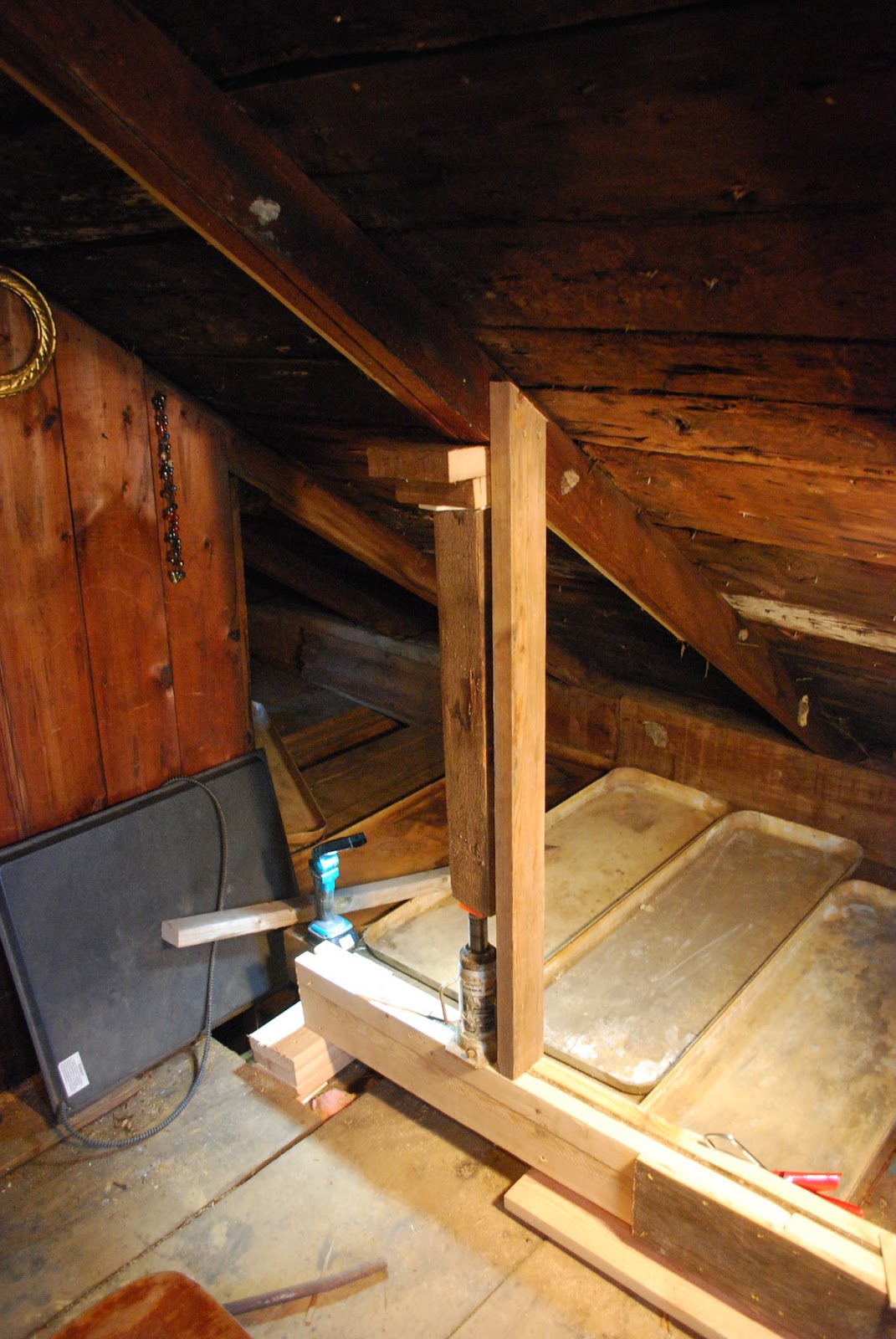
Next upright, showing the crazy jig (Wood-Form American. Okay that's enough of THAT nonsense) that had to be rebuilt and redesigned constantly. It would crack along grain lines, along screw holes, and anywhere pressure got too great and a weakness existed.

Speaking of cracks, this rafter was split along diagonal grain. I added a 'sister,' another piece of wood to add support, but decided I needed more once the rafter had been jacked and straightened.

Construction adhesive from a caulk gun was squished into the crack with a thin piece of shingle, clamps brought the rafter together, and three-inch screws completed the task.
I don't let things like this go without a fix.
We are not children here.

Yes indeedy. All upright supports are checked for plumb both ways, and when this entire process is completed, I'll have walls that can easily be sheathed with electrical wires running through them. They can be insulated and outfitted with access doors to store (hopefully less) junk within. I will essentially end up with a large room up there, though it will have a chimney in the middle of it. Yes, I could add a wood stove. Let's not get ahead of our purpose.

Looking towards the south window and all the tools, chargers, fans (it was pretty comfortable, since I sarated at eight in the morning), assorted junk, and of course, sweet little Samara Morgan watching over all procedures.
Just waiting to crawl through your teevee and scare you to DEATH!!!

Almost done.

Poor little jig did its job well because I kept adding to it as it cracked.

Oh, YEAH!
Floor cleaned, roof tighter than a tick a dog show, and boxes of junk stashed safely in the dry corner. A lot thrown away, as well.

I done good. The roof even looks a bit straighter from the road.
But this is only one fifth of the kneewalls. Four more plus two half-connectors to go.
And the next has to go where SHE lives, and I don't mean Samara Morgan.
I hope She won't mind.


